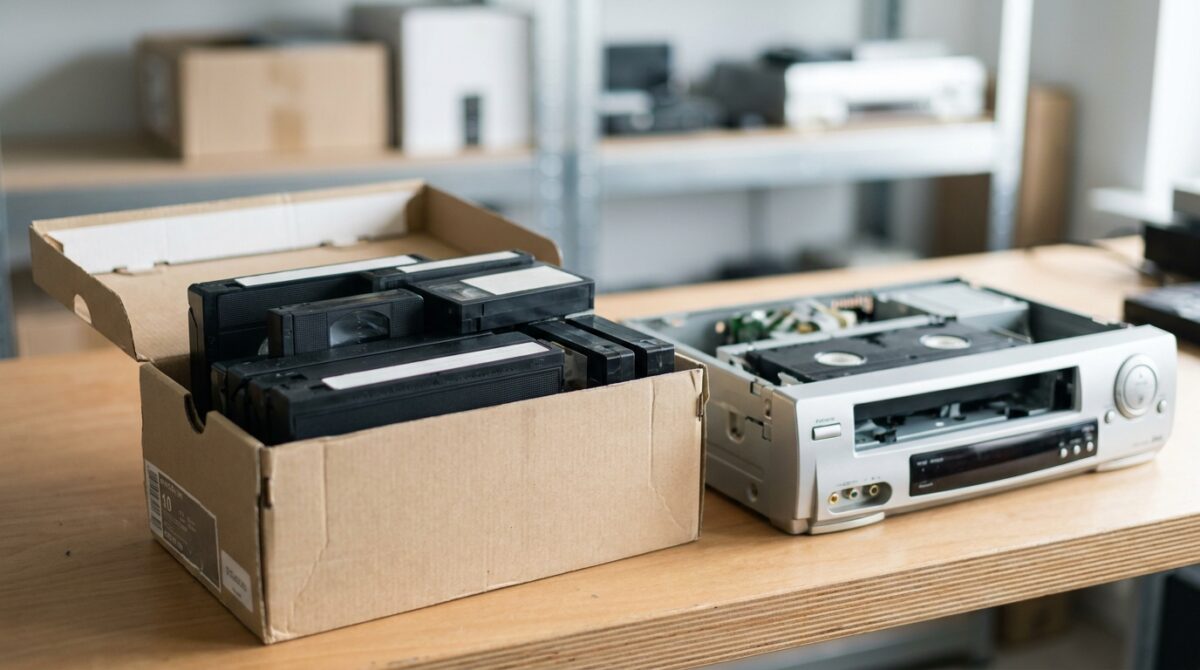
Doing it yourself is reasonable at roughly five to ten tapes if you already own a serviced deck; above that, a lab is almost always cheaper and safer. A serviced S-VHS deck with a time base corrector plus a decent capture card runs into the hundreds of dollars before you have digitised anything, and it takes real time either way. A lab prices per two-hour tape at one flat rate for any consumer format: $19.95 at the current special, $28.50 regular, with a $50.00 minimum order, as of September 2026. Rates and specials move, so check the video tape pricing page before you budget.
- Consumer formats are priced per two-hour tape, one rate whatever the format.
- A $50.00 minimum order applies, so very small jobs pay for the paperwork either way.
- Ten ordinary tapes works out to $199.50 at the special rate, against several hundred dollars of deck, time base corrector and capture card for the DIY route.
- Capture is real time. A six-hour VHS tape occupies a deck for six hours, whoever runs it.
- Blank stretches and off-air television are edited out and never billed.
- Mixed boxes are fine. Every tape is identified at intake, originals returned in the same shipment.
The situation you are actually in
There is a box. Someone’s handwriting on the labels, a wedding, two Christmases, a child who is now forty. No VCR in the house, or one in the garage nobody trusts. And the quiet worry underneath: that whatever is on these is already half gone.
That worry is mostly right about timing and mostly wrong about effort. The tapes do degrade. But the decision in front of you is not “restore these myself or lose them”, it is a plain cost comparison between buying playback equipment and renting someone else’s.
The honest case for doing it yourself
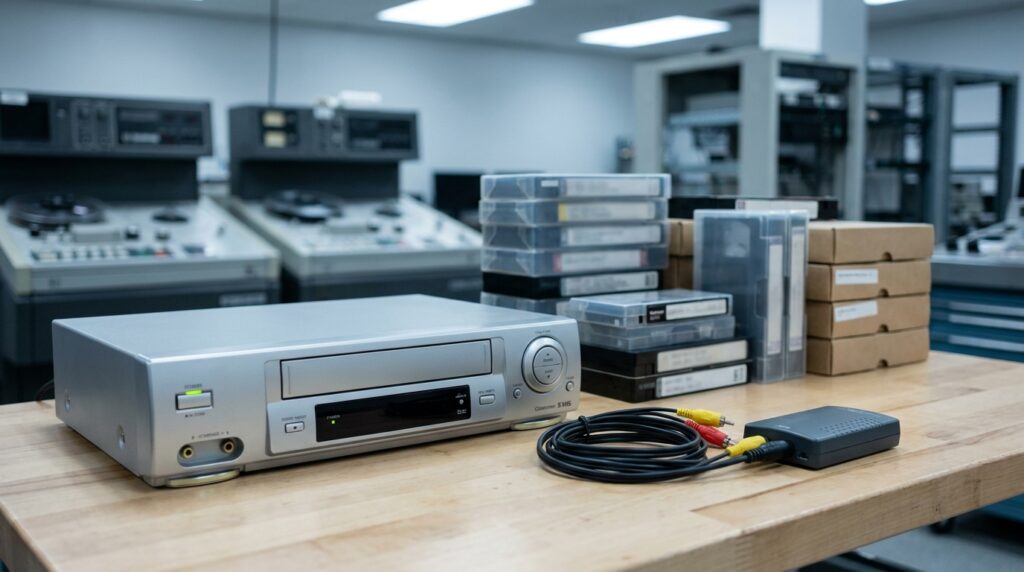
DIY or send it in?
Nobody should pretend a dongle is worthless. If you have a handful of tapes, an S-VHS deck that already works, and an evening a week, you can get a watchable file.
What it actually takes: a serviced S-VHS deck, because unserviced garage VCRs have hardened rollers and a drifting tracking servo; a time base corrector, because consumer VHS sync wanders and most capture hardware drops frames when it does; and a capture card rather than the cheapest USB stick. Together that is a few hundred dollars minimum, and used deck prices move constantly, so price your own before assuming.
The shortlist, if you are buying used
Decks. The names that come up again and again on the used market are the JVC HR-S9800U and its stablemate the HR-S7800U, both S-VHS machines with JVC’s line time base corrector and digital noise reduction built in, and the Panasonic AG-1980P, a prosumer S-VHS deck with its own TBC that is the usual first choice for troublesome tapes. Serviced examples of any of the three tend to sit in the mid hundreds of dollars on eBay, with unserviced units cheaper and, in the AG-1980P’s case, notorious for failing capacitors that a recap fixes. Budget for a service, not just a purchase: a deck bought as-is is an unserviced garage VCR with a better badge.
Time base correction. A deck with a built-in line TBC handles line-level jitter, but a full-frame TBC is the part that stops a drifting signal from dropping frames at capture. The DataVideo TBC-1000 is the standard answer here, a dedicated full-frame unit that has been the hobbyist default for years and sells used for roughly the price of a serviced deck. Some people substitute an older Panasonic or Sony DV camcorder passing composite through to FireWire, which works but gives you far less control.
Capture. Cards that take a clean composite or S-Video feed and hand over lightly compressed or uncompressed video are what you want: the Blackmagic Intensity Pro 4K on the internal side, or a used Canopus ADVC-110 converter for a DV workflow that is hard to get wrong. Avoid the five-to-twenty-dollar USB dongles sold as “VHS to digital” on marketplace listings, the EasyCAP-style sticks and their clones. They heavily compress on the fly, drop frames whenever sync wanders, and ship with drivers that change from batch to batch under the same product name. That is the one purchase in this list that reliably wastes both the money and the pass through the tape.
Below about five to ten tapes, with equipment already in hand, DIY is a fair call. Above that, the maths turns: the equipment cost stops amortising in your favour, and the real time cost is identical either way. Do the clock arithmetic for ten ordinary two-hour tapes before you commit: twenty hours of real-time capture that you have to be in the room for, plus the cleanup nobody budgets, roughly fifteen to thirty minutes a tape for trimming blank stretches, splitting a cassette that holds three unrelated events, naming the file and copying it somewhere safe. That is another three to five hours, so ten tapes is closer to a twenty-three to twenty-five hour project than a twenty-hour one. A single six-hour long-play VHS on its own is six hours of capture before any of that.
Where the line really is
The line is not tape count, it is condition. A clean tape from 1998 is forgiving. A tape that squeals, drags or smells musty is not, and that is the point where DIY stops being thrift and starts being risk. Each pass through the wrong deck takes something away permanently.
What a lab charges, and what determines the rest
How the charging works
Any consumer format is priced per two-hour tape, the same rate whether it is VHS, VHS-C, Video8, Hi8, Digital8, MiniDV or Betamax. A $50.00 minimum order applies, and any shortfall shows as a “Minimum order adjustment” line item. Specials move, so confirm against the pricing page or ask for a quote.
Ten ordinary two-hour tapes is ten line items: at the September 2026 special that is $199.50, at the regular rate $285.00, comfortably clear of the minimum either way. Set that against the DIY build for the same ten tapes: a serviced S-VHS deck, a time base corrector and a capture card land in the several hundreds before a single frame is captured, and you still owe the same twenty-plus hours of real-time playback. The equipment is a one-time cost, which is exactly why it only pays back if the box keeps growing.
A tape counts as one two-hour tape per two hours of recorded content: four hours counts as two, six hours as three. In practice only VHS runs past two hours, because of its long-play modes. Betacam and Betacam SP are broadcast formats and priced separately. The full table and worked examples sit on the video tape pricing page.
Compare the mechanic, not the headline number. Some large mail-in services bill per block of minutes, which means blank tape and off-air television are charged at the same rate as the wedding. Blank footage and randomly recorded television are edited out here and never billed.
Turnaround is not a fixed number and anyone quoting you one sight unseen is guessing. What sets it: tape count, total run time, format mix, condition and the current queue. Rush service is available at additional cost, quoted per order.
Three tapes off the bench, and what they gave back
Vague talk about “limits” helps nobody, so here is how the common failures usually behave.
Sticky-shed VHS. The binder absorbs moisture, the tape squeals and drags, and residue builds on the head. Caught before repeated home playback, most still transfer. The tell is that the first home “test” already cost the tape something.
Mould on an 8mm camcorder cassette. White powder along the pack edge. It spreads with every pass in the wrong deck. These often still convert, but never on a promise made before the tape has been run.
Forty-year-old Betamax. Usually still saveable. The sooner a tape is digitised, the more survives. Details on decks and pricing for that format are on the Betamax and Betacam page.
What we will not do is tell you a specific tape will come back before it has been through a deck. Troublesome tapes are tried in more than one deck to get the best signal the tape can give, and then you are told plainly what it gave.
Betamax is a consumer format. Betacam is a professional broadcast format that plays on entirely different equipment, and it is priced separately. The names look alike; the machines do not.
Stop doing these things while you decide
- Stop rewinding any tape that squeals or drags.
- Stop “just testing” tapes in an old VCR to see which still play.
- Never record over a tape you are unsure about.
- If a tape smells musty or shows white powder, bag it separately and say so.
You also do not need to identify anything first. VHS-C is the same tape as VHS in a smaller camcorder shell, so no adapter is needed. Video8, Hi8 and Digital8 look nearly identical and are told apart by the recording, not the label. Betamax cassettes are smaller and squarer than VHS and usually say Beta on the shell. If you want to sort yours anyway, the which video tape do I have guide takes two minutes. One disambiguation that catches people: 8mm video tape is a cassette, not 8mm film, which is a reel with sprocket holes.
What comes back either way
Each tape becomes an MP4 file, deliberately low-compression. Expect roughly five times the drive space of a heavily compressed mail-in transfer, which is the point: VHS has little resolution to spare and squeezing it throws away what is left. In round numbers that is on the order of 10 to 15 GB for a full two-hour tape at our settings, against the one to three GB a heavily compressed service would hand you for the same footage. Hold two useful figures: roughly 5 to 8 GB per recorded hour, and a little over 100 GB for a box of ten two-hour tapes. A six-hour long-play VHS counts as three tapes and lands in the same territory, 30 to 45 GB on its own. That is why files arrive on a flash drive under 256 GB and a hard drive above that: about twenty full tapes is where a drive becomes the sensible container. Tapes with long blank stretches come in well under these figures, because blank footage is edited out and never billed or stored. DVDs are available alongside or instead on archival discs. Originals always return in the same shipment, and converting a tape does not harm it.
If you are weighing discs against files, that decision lives on the tape to DVD or digital files page. When you are ready to hand the box over, the service itself is described on the convert video tapes to digital page.
Who would be handling them
Legacy Digital Productions has been family owned in Orange, California since 2001, which is 25 years in our own lab as of August 2026, with nearly 20,000 satisfied customers. Founder Scott Foster still does the work himself, and the person who quotes your job is the person who inspects it. The parent lab converted the Arnaz family’s personal video tapes for Netflix’s “Lucy and Desi” and Steven Spielberg’s childhood films for “Spielberg”.
On why tapes deteriorate, and how to compare transfer services generally, Legacy Digital has already written both: see their articles on why video tapes are fading and how to choose a VHS to digital service.
Frequently asked questions
Is it cheaper to convert VHS tapes to digital myself?
Only at small counts with equipment you already own. A serviced S-VHS deck, a time base corrector and a capture card cost several hundred dollars before the first tape, while ten ordinary two-hour tapes sent in comes to $199.50 at the September 2026 special rate. Below roughly five to ten tapes DIY can make sense; above that the equipment cost rarely pays back. Check current rates on the pricing page.
How long does converting VHS tapes to digital take?
Capture is real time, so a two-hour tape occupies a deck for two hours and a six-hour VHS for six. Total turnaround depends on tape count, run time, format mix, condition and the current queue, so ask for a current estimate rather than trusting a fixed figure.
Can a VHS tape that squeals or sticks still be converted?
Frequently, yes. Sticky-shed and mould are common and often still transferable when caught early. Stop playing the tape at home, because every pass in the wrong deck makes it worse. No lab should promise a specific tape can be recovered before running it.
Are tapes recorded off television converted?
No. Home-made content only: family recordings, weddings, events and interviews. Commercial copyrighted material and off-air programmes are not converted, and any such footage on a family tape is edited out and not billed.
Do I need a VCR or to know my format before sending tapes?
No to both. You do not need a VCR, a camcorder, a FireWire cable or a VHS-C adapter, and mixed boxes are identified at intake. Send a photo of one cassette and a rough count to get a free quote.