VHS and VHS-C
VHS to digital conversion service, done one tape at a time.
VHS is the format most people have the most of, and the only one that routinely hides six hours on a cassette. Here is what a transfer involves, what it costs, and what to do with the tapes that no longer play properly.
What you get back, and why the files are big.
Each tape becomes an MP4 file, captured in real time from a maintained deck and deliberately low-compression. Expect our files to need roughly five times the drive space of a heavily compressed mail-in transfer. That is the point: VHS has little resolution to spare, and squeezing it further throws away the little that is left. Files come back on a flash drive for orders under 256 GB, or a hard drive above that. DVDs are available alongside or instead.
Blank stretches and anything recorded off television are edited out and never billed. You pay for the family footage that is actually on the tape.
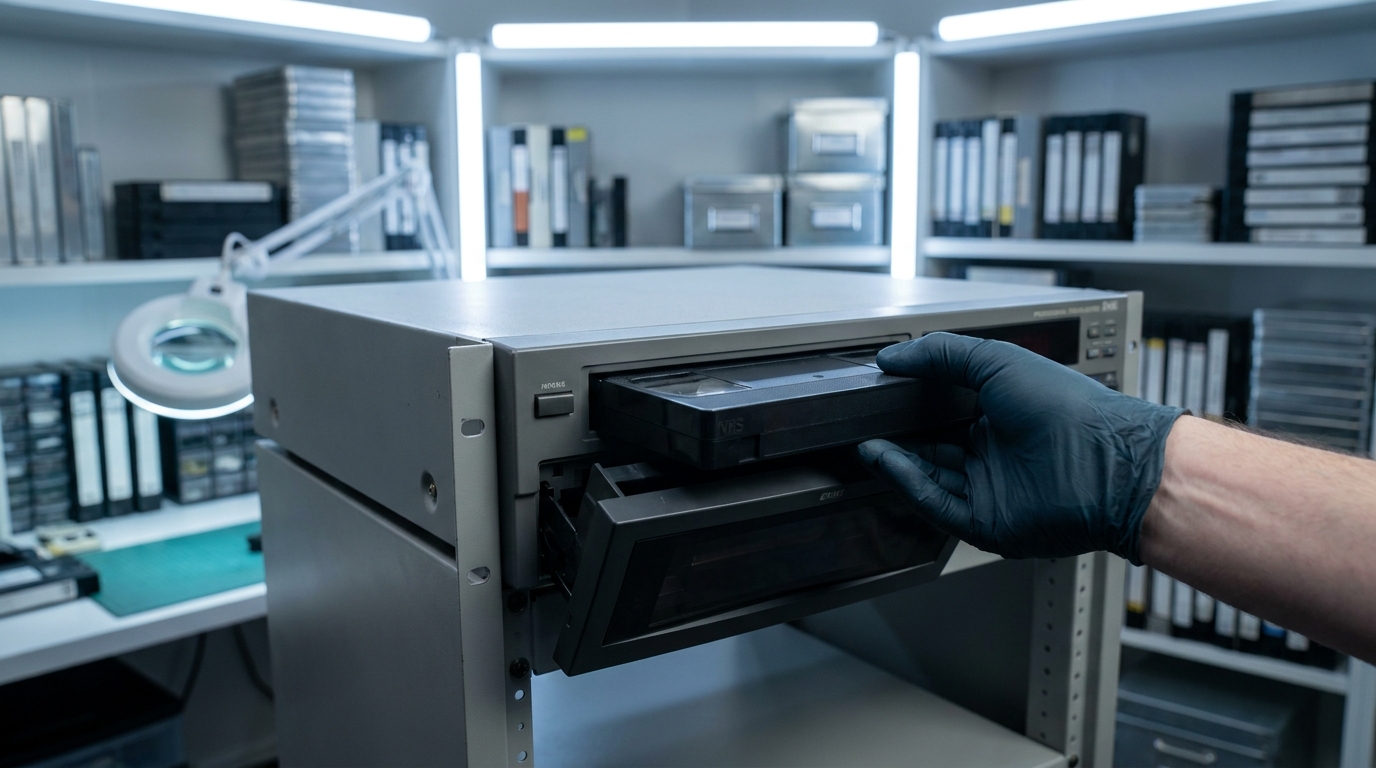
Three things that are specific to VHS
It can run past two hours
A standard cassette holds two hours at normal speed and up to six in long-play modes. We bill per two hours of recorded content, so a six-hour tape counts as three. Camcorder formats almost never do this.
VHS-C is the same tape
VHS-C is the palm-size camcorder version of VHS: the same tape in a smaller shell that needed an adapter to play in a VCR. You do not need the adapter, or the camcorder. Send the small cassettes as they are.
S-VHS is welcome too
Super VHS recorded a sharper picture on a similar shell. We handle it on the same terms. If you are not sure which you have, the label usually says, and if it does not, we will tell you.
Sticky, squealing or mouldy?
Stop playing it at home. Sticky-shed and mould get worse with every pass through the wrong deck. Caught early, most affected tapes still transfer, so send them in sooner rather than later and tell us what you noticed.
Recorded overseas?
Our standard is NTSC, the North American system. If your tapes were recorded in a PAL or SECAM country, call before you ship so we can confirm handling for those specific tapes.
Home recordings only
Weddings, birthdays, school plays, interviews. We cannot convert commercial copyrighted tapes or programmes recorded off television, and we edit recorded TV out of home tapes rather than billing for it.
What it costs
Every consumer format is priced the same way, per two-hour tape. For a box of ordinary two-hour VHS cassettes the arithmetic is simple: the number of tapes times the rate. Long-play tapes are the exception, and the pricing page has worked examples for both.
The two-hour rule. A tape counts as one two-hour tape per two hours of recorded content. Two to four hours counts as two tapes, four to six as three, and so on. Only VHS typically runs past two hours, because its long-play modes could squeeze six hours onto one cassette. Camcorder formats almost never do.
Per two-hour tape, any consumer format
$19.95 at the current special
$28.50 at the regular rate. VHS, VHS-C, Video8, Hi8, Digital8, MiniDV, Betamax: same price. A $50.00 minimum order applies. Blank footage and recorded television are edited out and never billed. Published rates as of September 2026; specials move, so ask for a current quote.
Two things worth reading before you send anything.
Our parent lab has already written the two pieces people ask about most, and rather than repeat them here we would rather send you to the originals: why video tapes fade, and how to judge any VHS to digital service, including this one.
Drop off in person, or ship
202 W Lincoln Ave, Suite A
Orange, CA 92865
Walk in Mon to Fri, 9:00am to 4:30pm. Call ahead so someone is free to log your tapes in properly. Shipping from anywhere in the country is fine: every tape is logged at intake and returned in the same shipment as your files.
Ready when your tapes are.
Send a photo of one cassette and roughly how many you have. If some no longer play, say so, and stop trying them at home.